
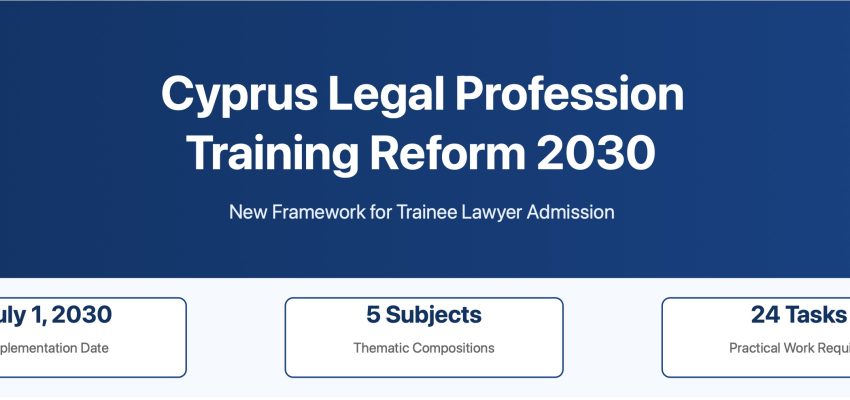
Cyprus Legal Council Reforms Lawyer Training Framework
Cyprus Legal Profession Undergoes Major Reform: Complete Guide to New Trainee Lawyer Framework
Official Announcement from Cyprus Legal Council on Institutional Framework Reform for Lawyer Admission
The Cyprus Legal Council has announced a comprehensive overhaul of the institutional framework governing the admission of trainee lawyers (ασκούμενος δικηγόρος) into the legal profession. This landmark reform, effective from July 1, 2030, represents a fundamental restructuring of how legal education and professional development will be conducted in Cyprus.
Why Cyprus Is Reforming Its Lawyer Training System
The legal profession in Cyprus is evolving rapidly under the influence of technology, increasing case complexity, and the need for immediate, effective, and practical legal services delivery. The existing training framework—which for decades has relied primarily on theoretical approaches with limited practical training—no longer adequately meets the real-world needs of modern lawyers.
Key Drivers of Reform
Technology Integration
Digital tools, legal research platforms, and document automation systems have become essential to legal practice, requiring lawyers to possess technical competencies that traditional training frameworks do not address.
Case Complexity
Modern legal matters have become increasingly intricate and multifaceted, requiring lawyers to develop sophisticated problem-solving skills beyond theoretical knowledge.
Practical Service Delivery
Clients expect immediate, effective, and practical legal services. The profession must ensure that newly qualified lawyers can deliver these services competently from day one.
Objectives of the New Framework
The Legal Council has implemented this reform with four specific objectives:
- Strengthen Practical Training: Move beyond theoretical education to ensure lawyers acquire hands-on experience and practical competencies.
- Ensure Professional Skills Development: Ensure that every new lawyer possesses basic professional skills including lawyer competencies (advocacy skills), legal document drafting, case management, and related practical capabilities.
- Achieve Quality Uniformity: Create consistency in the quality of training across all trainee lawyers, regardless of where or with whom they complete their apprenticeship.
- Establish an Effective, Fair, and Modern Assessment System: Replace outdated evaluation methods with contemporary, transparent, and fair assessment mechanisms.
The new framework aims to make trainee lawyer education more structured, demanding, and oriented toward real legal work, while simultaneously protecting trainee lawyers and ensuring the quality of the profession.
Implementation Timeline: Key Dates
Transitional Period: 2025-2030
Existing trainee lawyers and those registering by June 30, 2030, will continue under the current system. They must:
- Complete their training under existing regulations
- Pass the ten (10) subjects currently required
- Achieve this by June 2032 examination session (maximum two years from the new framework’s start)
Important: Those who fail to pass all ten subjects by June 2032 will transition to the new system.
New Course Structure: Five Thematic Compositions
The reformed framework organizes subjects into five (5) thematic compositions:
3.1 Public Law Composition
Covers constitutional, administrative, and public law subjects essential for modern legal practice.
3.2 Substantive Criminal Law, Criminal Procedure, Evidence, Sentencing, and Lawyer Skills
Combines criminal law theory with procedural knowledge, rules of evidence, sentencing principles, and essential lawyer competencies.
3.3 Civil Law, Evidence, and Lawyer Skills
Addresses civil law substantive issues, evidentiary rules in civil matters, and practical lawyer skills for civil practice.
3.4 Civil Procedure Rules and Lawyer Skills
Focuses on procedural aspects of civil litigation and the practical skills required for civil court practice.
3.5 Courts Law, Legal Ethics, and Lawyer Skills
Covers the institutional framework of the judiciary, professional ethics obligations, and related practical competencies.
Lecture Structure and Requirements
Lecture Scheduling and Delivery
Lecture Period: October through April (completion before end of April)
Delivery Method: All lectures are conducted remotely via the Cyprus Bar Association’s electronic platform, making legal education accessible to all trainee lawyers.
Recording and Access: All lectures are recorded and uploaded to the Cyprus Bar Association’s platform, allowing trainee lawyers to review material asynchronously if needed.
Attendance Requirements for Live Lectures
- Minimum Attendance: Trainee lawyers must attend at least 70% of live lectures.
- Camera Requirement: During live lectures, trainee lawyers must keep their cameras on (mandatory).
- Exception Process: The Legal Council may accept a lower attendance percentage in exceptional cases, at its absolute discretion, upon written, justified request from the trainee lawyer.
Late Enrollment
Trainee lawyers who register after lectures have begun must:
- Watch at least 70% of recorded lectures from the Cyprus Bar Association platform
- Attend a three-hour lecture in each subject during May-June for clarification of questions
Attendance Certification
Requirement for Examination Eligibility: To qualify to sit examinations, trainee lawyers must submit to the Legal Council a certification of lecture attendance (either live or recorded, as applicable) from the Cyprus Bar Association.
Examination System and Requirements
Examination Sessions
The new framework establishes three examination sessions per year:
- June: The primary examination session (all trainee lawyers take their first-attempt exams here)
- October: Secondary examination session for those who failed partially or wholly in June
- February: Tertiary examination session for those who failed in previous sessions
Note: October and February sessions are available only to those who have failed in previous examination periods, unless the Legal Council grants special permission.
Passing Grades and Consolidation of Results
- Minimum Pass Mark: 50% in each subject constitutes a passing grade.
- Consolidation of Three (3) Passing Subjects: May be consolidated only if the average mark across all three subjects is at least 60%
- Consolidation of Four (4) or More Passing Subjects: Consolidated automatically regardless of individual subject grades
The Three-Examination Rule
Core Requirement: Trainee lawyers must pass all five (5) subjects within three (3) consecutive examination sessions, beginning with the primary June session.
Example Timeline: If a trainee’s first attempt is June 2030, they must pass all five subjects by February 2031 (June, October, February).
What Happens If You Don’t Pass All Subjects in Three Sittings
Extended Practical Period
If a trainee lawyer has not passed all five subjects within the three consecutive examination sessions, they may:
- Continue their practical training for an additional 12 months
- Retake all five subjects during the next three consecutive examination sessions (specifically June, October, and February)
Completion Upon Success: If the trainee passes all subjects during this extended period, the 12-month extended practical training is deemed completed simultaneously with passing the examinations.
Failure After Extended Period
- Termination of Training: If the trainee lawyer fails to pass all subjects within the 12-month extension and subsequent three examination sessions, their training terminates.
- Reinstatement Possible: They may reapply and restart their training after a two-year waiting period, subject to the same requirements and conditions outlined above.
Special Circumstances and Exceptions
The Legal Council may grant relief in special circumstances (accidents, serious illness, bereavement) upon written, justified request. Allowed exceptions include:
5.11.1 Same-Session Rescheduling
The Legal Council may allow a trainee to sit all or some subjects in a new date within the same examination session in which they are currently enrolled.
5.11.2 Extended June Sitting
For trainee lawyers who have failed some (but not all) subjects by February, the Legal Council may allow them to sit the failed subjects in the following June session. If they fail again and fall under section 5.8 provisions, they may take all remaining subjects only in October and February following.
5.11.3 October as First Examination Session
The Legal Council may allow a trainee to sit their first examination in October instead of June. They may then take remaining subjects in February and June. If they fail and fall under section 5.8, they may take remaining subjects only in October and February.
5.11.4 Request Submission Requirements
- Must be submitted within 5 days of when the need arose
- Must be accompanied by necessary supporting documentation
Mandatory Practical Work Completion
Beyond attending lectures and passing the five subject examinations, trainee lawyers must complete practical tasks to ensure they acquire essential equipment for legal practice—gaining experience through actual engagement with legal work.
Practical Work Options
Trainee lawyers must complete either:
- Option A: Any six (6) tasks from the Appendix A list, OR
- Option B: Double the number of any three (3) tasks from the Appendix A list (i.e., 6 tasks total, but only 3 different types, each repeated twice)
Verification of Practical Work
These tasks must be verified by:
- The trainee lawyer and the supervising lawyer
- Any other method the Legal Council decides
Comprehensive List of Practical Work Tasks (Appendix A)
Trainee lawyers may select from the following 24 categories of practical work:
Legal Written Work
- Two (2) Legal Opinions (Νομικές Γνωματεύσεις) – Professional written legal advice on substantive issues
- Two (2) Interrogatories (Σύνταξη Ερωτηματολογίων Οδηγιών) – Written questions for discovery in civil litigation
- Two (2) Indictments (Σύνταξη και Προετοιμασία Κατηγορητηρίων) – Criminal charging documents
- Two (2) Pleadings or Appeals (Σύνταξη Εναρκτηρίων ή Εφέσεων/Αιτήσεων) – Initial statements of claim or appellate documents, including privileged warrants
- Two (2) Pre-Trial Protocols (Σύνταξη Προδικαστικών Πρωτοκόλλων) – Procedural documents for pre-trial case management
- Two (2) Court Pleadings (Σύνταξη Δικογράφων ενώπιον Δικαστηρίου) – Documents filed in court proceedings
- Two (2) Interlocutory Applications (Σύνταξη Ενδιάμεσων Αιτήσεων) – Interim relief applications with supporting sworn statements
- Two (2) Appeals (Σύνταξη Προσφυγών) – Hierarchical appeals, review appeals, or appeals under the Appeals Law, N. 6(I)/2000
- Two (2) Contracts (Σύνταξη Συμβολαίων) – Commercial or personal agreements
Corporate and Commercial Documentation
- Three (3) Constitutional or Founding Documents (Σύνταξη Ιδρυτικών/Καταστατικών Εγγράφων) – Formation documents for companies, cooperatives, or foreign companies
- Five (5) Company Documents (Σύνταξη Εγγράφων Εταιρείας) – Stock transfers, director/secretary replacements, registered office changes
- Two (2) Trust Documents (Σύνταξη Εγγράφων Δημιουργίας Εμπιστεύματος) – Trust creation and management documents
Intellectual Property and Business Registration
- Two (2) Trademark Registrations (Δύο Εγγραφές Εμπορικού Σήματος) – Trademark application and registration procedures
- Two (2) Business Name Registrations (Δύο Εγγραφές Εμπορικής Επωνυμίας) – Business registration filings
Property and Maritime Law
- Two (2) Ship Registration or Transfer Documents (Σύνταξη Εγγράφων Εγγραφής/Μεταβίβασης Πλοίου) – Maritime vessel documentation
Estate and Trust Administration
- Two (2) Will Administration Procedures (Δύο Διαδικασίες Διαχείρισης ή Εκτέλεσης Διαθήκης) – Estate management and will execution processes
Power of Attorney
- Two (2) General or Special Power of Attorney (Ετοιμασία Γενικών ή Ειδικών Πληρεξουσίων) – Preparation of attorney-in-fact documents
Immigration and Residence Permits
- Two (2) Documents and Three (3) Applications for Residence Permits (Ετοιμασία Δύο Εγγράφων και Υποβολή Τριών Αιτήσεων) – Residence permit documentation and application submissions to competent authorities
Court Experience and Advocacy
- Two (2) Interlocutory Hearings (Δύο Ακροάσεις Ενδιάμεσων Αιτήσεων) – Attendance at interim relief hearings accompanied by supervising lawyer
- Five (5) Full-Day Court or Arbitration Hearings (Πέντε Ημερήσιες Ακροάσεις) – Full-day appearances in any court or commercial arbitration proceedings, with supervising lawyer
- Five (5) Appearances for Directions (Πέντε Εμφανίσεις για Οδηγίες) – Court appearances excluding hearings (case management appearances)
Client and Investigative Work
- Two (2) Client Interviews (Δύο Συνεντεύξεις με Πελάτες) – Client meetings with or without supervising lawyer present
- Document Disclosure Preparation in Two (2) Cases (Προετοιμασία Αποκάλυψης Εγγράφων) – Discovery processes including preparation of sworn statements
- Two (2) Client Statement-Taking Sessions (Παραστάσεις για Λήψη Καταθέσεων) – Attendance with supervising lawyer at police stations, detention facilities, prisons, or government agencies for taking client statements
Regulations and Ongoing Guidance
The Legal Council retains the authority to issue Regulations and Guidelines from time to time to ensure more effective implementation of the above provisions.
Legislative Implementation
Where legislative changes are necessary to implement these provisions, appropriate procedures will be initiated.
What This Reform Means for Cyprus’s Legal Profession
Elevated Professional Standards
The new framework significantly raises the bar for lawyer admission. Newly qualified lawyers will have demonstrated competency in five distinct areas of law and practical legal skills, ensuring that the profession maintains high standards.
Structured Practical Experience
Unlike the previous system where practical training was less formalized, trainee lawyers now engage with concrete legal tasks—drafting real documents, appearing in court, meeting with clients, and managing cases. This ensures they develop genuine, applicable skills before independent practice.
Quality Consistency
By establishing uniform requirements across all trainee lawyers, the framework creates consistency in professional quality. A lawyer trained under the new system will have completed substantially the same work and demonstrated the same competencies regardless of which law firm or supervising lawyer guided their training.
Modern Assessment System
The examination structure—with three opportunities to sit each subject, attendance certification requirements, and provisions for special circumstances—reflects contemporary educational principles while maintaining rigor.
International Competitiveness
Cypriot lawyers trained under this more rigorous and practically-focused framework will be better equipped to compete in the international legal marketplace and handle cross-border transactions with confidence.
Key Advantages for Trainee Lawyers
- Clear Requirements: Transparent expectations for what must be accomplished
- Multiple Examination Opportunities: Three sittings per year provide flexibility
- Practical Relevance: Tasks directly relate to work they will perform as qualified lawyers
- Flexible Scheduling: Remote lectures via electronic platform accommodate various life situations
- Special Circumstances Relief: Built-in provisions for emergencies, illness, or unforeseen hardship
Implementation Support
The Cyprus Bar Association and Legal Council are committed to:
- Clear Communication: Providing detailed guidance on the new requirements
- Resource Development: Creating training materials and implementation guidance
- Stakeholder Coordination: Working with law firms and legal educators for smooth transition
Professional Responsibilities During Implementation Period
- For Law Firms: Ensure trainee lawyers receive proper supervision and have opportunities to complete required practical tasks.
- For Supervising Lawyers: Guide and verify trainee lawyers’ completion of practical work tasks as required.
- For Trainee Lawyers: Maintain records of attendance, engage actively in required practical work, and meet all deadline requirements.
Final Conclusion
The Cyprus Legal Council’s reform of the trainee lawyer framework represents a transformative moment for legal education in Cyprus. By combining structured lectures in five thematic areas, rigorous examinations with multiple opportunities, and mandatory practical work across a comprehensive range of legal tasks, the new system ensures that newly qualified lawyers are genuinely prepared for independent practice.
This reform responds to the evolving needs of the legal profession in the 21st century—a profession increasingly shaped by technology, international practice, and complex legal matters. The trainee lawyers who complete their training under the new framework will emerge with demonstrable competencies in both theoretical knowledge and practical application.
For the Cyprus legal community, this reform represents investment in quality, professionalism, and the long-term standing of the legal profession. It acknowledges that legal practice has changed dramatically and that legal education must change with it.